

NVIDIA Jetson Nano Developer Kit – 4GB
NVIDIA announced the Jetson Nano Developer Kit at the 2019 NVIDIA GPU Technology Conference (GTC), a $99 computer available now for embedded designers, researchers, and DIY makers, delivering the power of modern AI in a compact, easy-to-use platform with full software programmability. Jetson Nano delivers 472 GFLOPS of compute performance with a quad-core 64-bit ARM CPU and a 128-core integrated NVIDIA GPU. It also includes 4GB LPDDR4 memory in an efficient, low-power package with 5W/10W power modes and 5V DC input.
The newly released JetPack 4.2 SDK provides a complete desktop Linux environment for Jetson Nano based on Ubuntu 18.04 with accelerated graphics, support for NVIDIA CUDA Toolkit 10.0, and libraries such as cuDNN 7.3 and TensorRT 5.The SDK also includes the ability to natively install popular open source Machine Learning (ML) frameworks such as TensorFlow, PyTorch, Caffe, Keras, and MXNet, along with frameworks for computer vision and robotics development like OpenCV and ROS.
Full compatibility with these frameworks and NVIDIA’s leading AI platform makes it easier than ever to deploy AI-based inference workloads to Jetson. Jetson Nano brings real-time computer vision and inferencing across a wide variety of complex Deep Neural Network (DNN) models. These capabilities enable multi-sensor autonomous robots, IoT devices with intelligent edge analytics, and advanced AI systems. Even transfer learning is possible for re-training networks locally onboard Jetson Nano using the ML frameworks.
The Jetson Nano Developer Kit fits in a footprint of just 80x100mm and features four high-speed USB 3.0 ports, MIPI CSI-2 camera connector, HDMI 2.0 and DisplayPort 1.3, Gigabit Ethernet, M.2 Key-E module, MicroSD card slot, and 40-pin GPIO header. The ports and GPIO header works out-of-the-box with a variety of popular peripherals, sensors, and ready-to-use projects, such as the 3D-printable deep learning JetBot that NVIDIA has open-sourced on GitHub.
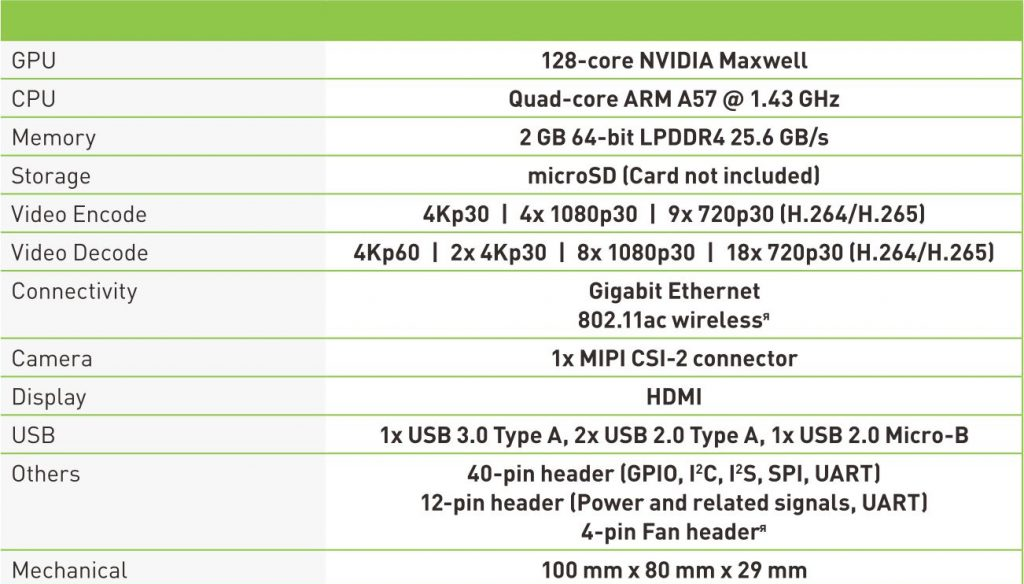
The devkit boots from a removable MicroSD card which can be formatted and imaged from any PC with an SD card adapter. The devkit can be conveniently powered via either the Micro USB port or a 5V DC barrel jack adapter. The camera connector is compatible with affordable MIPI CSI sensors including modules based on the 8MP IMX219, available from Jetson ecosystem partners. Also supported is the Raspberry Pi Camera Module v2, which includes driver support in JetPack. Table 1 shows key specifications.
Deep Learning Inference Benchmarks
Deep Learning Inference Benchmarks Jetson Nano can run a wide variety of advanced networks, including the full native versions of popular ML frameworks like TensorFlow, PyTorch, Caffe/Caffe2, Keras, MXNet, and others. These networks can be used to build autonomous machines and complex AI systems by implementing robust capabilities such as image recognition, object detection and localization, pose estimation, semantic segmentation, video enhancement, and intelligent analytics.
Figure 3 shows results from inference benchmarks across popular models available online. See here for the instructions to run these benchmarks on your Jetson Nano. The inferencing used batch size 1 and FP16 precision, employing NVIDIA’s TensorRT accelerator library included with JetPack 4.2. Jetson Nano attains real-time performance in many scenarios and is capable of processing multiple high-definition video streams.